Energy news from Omaha Public Power District
Energy news from Omaha Public Power District
New skills test helps OPPD find the next generation of steamfitters
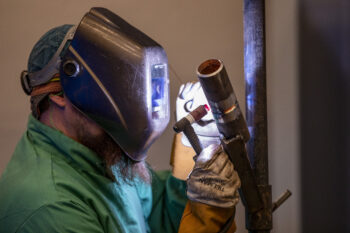
Not many job interviews require physical labor in a dark, underground vault.
But OPPD’s steamfitter mechanics face all kinds of complex, demanding challenges, and a new skills assessment to test job candidates is no exception.
So when Eric Devney screened recently for one of two open steamfitter mechanic jobs, he spent most of the day in work gloves, boots and a helmet.
“I didn’t really know what to expect,” said Devney, one of two applicants hired. “I was thinking it would be more of a regular interview, but I’m glad it was set up the way it was because it allowed me to show my skills.”
Devney and other job applicants demonstrated their rigging, welding, metal cutting and pipe-replacement abiliities as seasoned OPPD steamfitters and managers scrutinized their work. Between stations, applicants sat for a more formal interview with OPPD recruiters.
“We’re not just testing for the right skills,” said OPPD Steamfitter Mechanic Shawn Holle. “We’re looking at how well we can work with the person.”
A high-stakes job
Steamfitter mechanics, known as “steamfitters” or “fitters,” are jacks-of-all-trades who install, maintain and repair the high-pressure piping systems needed to generate reliable power throughout eastern Nebraska. Their work is more important than ever as OPPD strives to meet unprecedented new demand for electricity.
Steeamfitters manage all kinds of equipment, from water tubes to the conveyor belts that move coal into OPPD’s Nebraska City Station and North Omaha Station. Some operate cranes, others help with construction work.
During the winter, steamfitters might find themselves clearing six inches of ice from a plant roof, or working underwater in the frigid Missouri River to inspect water intake screens.
In the summer, they might toil in 120-degree heat inside a plant with a welding torch that can reach up to 6,000 degrees.
A real-world test
Halfway through his skills assessment at Nebraska City Station, Devney arrived at a manhole leading to the utility’s new underground training vault.
His assignment: descend a 16-foot ladder into the cramped, 12-by-8-foot workspace and find a pipe spool with tag number 1MPF1616A. Then remove the spool safely, install a replacement piece and reinsert the pipe’s metal gasket to prevent leaks. For Devney, an experienced boilermaker, the vault was no different than the hundreds of other workspaces he’d encountered in industrial plants and refineries.
“Are you good going into confined spaces?” asked Tyler Holmes, an OPPD steamfitter mechanic.
Devney nodded then slowly, carefully lowered his canvas tool bucket into the hole and followed it down.
Finding the right fit
OPPD adopted the assessment program to ensure job applicants have the skills, work ethic and attitude to meet the utility’s needs. Aspiring line technicians undergo a similar type of testing when they apply.
“It weeds out the people who built their resume just based on the job criteria,” said OPPD Steamfitter Mechanic Tom Brammier. “If we didn’t do this assessment, we might not know their abilities right away.”
A steamfitter’s life is tough but rewarding. The hours can be long, in tight, cramped spaces, around large and heavy machinery, in plants generating thousands of megawatts of electricity. Safety is paramount.
“We look for a lot of things,” Holmes said. “Can you follow instructions? Are you working on the right equipment? Can you install a flange properly? Can you function in confined spaces?
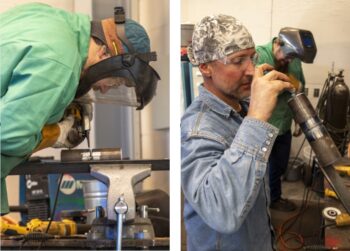
Every member of the team has a specialty. Some are better welders, others more talented at cutting or rigging pipes into place to make repairs.
Evaluators look for applicants who ask questions, accept feedback, spot and correct mistakes, and power through tricky situations. During one tough assessment recently, a frustrated applicant threw his sling on the floor.
“You may start to see a little bit of their character just by the way they handle themselves and interact with you,” Brammier said.
When applicants struggle, the evaluators sometimes offer small hints help them work through the problem.
“Some of the stuff we’re doing here to test them is journeyman-level work,” Holmes said. “We don’t necessarily expect them to know everything. The people we’re hiring might have some of that experience, but they don’t necessarily have all the qualifications they’ll need just yet.”
Helping as a beginner
New hires start as helpers, whose job for the first six months is to learn the basics. They enter an apprenticeship with two potential paths: They can route through the traditional four-year program or, if they have the experience to pass a key test, they can finish the apprenticeship in two years but with the same reading required of the traditional full-length apprenticeship.
At the end, apprentices must pass an oral and written exam before a committee composed of seasoned steamfitter mechanics and managers.
Attention to detail is key. So is a willingness to learn. OPPD wants problem-solvers who can adjust to their situation and work well with others. A world-class welder with a bad attitude might not get the job.
Holle said the new hiring approach has worked well.
“The last two guys hired for our shop did this assessment, and they were really good,” he said.
Making the (metal) cut
Applicants come from all backgrounds, including boilermakers from outside companies and others within OPPD. Others are graduates of Southeast Community College or the Missouri Welding Institute in Nevada, Missouri.
Inside OPPD’s training center at Nebraska City, applicants cut metal into squares with torches to show the precision and quality of their work. Blinding sparks spray through the air and skitter across the floor. Other applicants weld pieces of metal, their torches pulsing with white-hot energy.
Still another testing station requires applicants to inspect rigging straps for signs of wear.
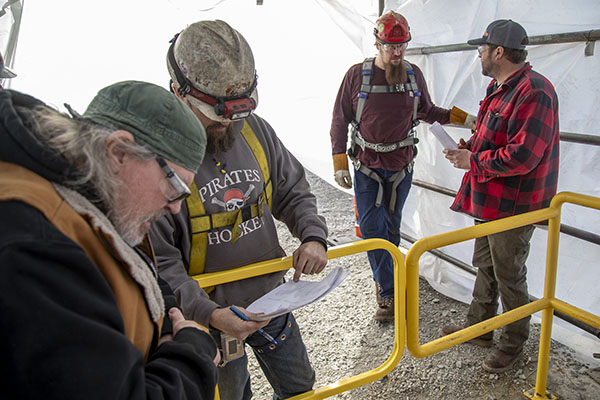
Rigging is the art of safely attaching slings to heavy pipe sections so that steamfitters can hoist and weld them into place. The work is precise and requires the right combination and placement of slings to ensure nothing can slip or fall. Improper loading could damage equipment or cause serious injury.
Brammier and Holle quiz applicants on various types of straps and swivels and ask them to identify warning signs that would render equipment unsafe. Burn marks, structural tears or exposed internal threading can weaken a strap enough to cause a catastrophic failure. Some straps could have a missing safety tag to specify their load ratings.
During the assessment, applicants must hoist a 150-pound pipe section using a safe, proper sling configuration.
A straight-leg (or vertical) hitch connects one end of the sling to a hoisting device and the other directly to the load.
A basket hitch spreads the load evenly by cradling the load underneath the sling and attaching the two end-loops to the hoisting device.
A choker hitch holds a load more securely by wrapping a sling around the object to be lifted, then passing one end-loop through the other and attaching it to the hoisting device. Each configuration has its uses and tradeoffs.
A demanding position
Steamfitters work days, nights and holidays, year-round. Some shifts run up to 12-15 hours a day just to make unexpected repairs and keep critical power flowing. If machinery breaks or someone gets sick, others must step forward to help.
One year on July 4, a newly hired steamfitter worked a 12-hour shift. Last year, one top-tier applicant bowed out due to the necessary time commitment.
“You can’t always plan for it, but things happen sometimes,” Brammier said. “During outage season (to perform maintenance), we spend more time here than we do with our own families. But the job’s got to get done. It’s part of the gig.”

Grant Schulte joined OPPD as a content generalist in 2022. He is a former reporter for The Associated Press, where he covered the Nebraska Legislature, state politics and other news for a global audience. He is a graduate of the University of Iowa and a proud Hawkeye. In his free time he enjoys running, reading, spending time with his wife, and all things aviation.
View all posts by Grant Schulte >