Energy news from Omaha Public Power District
Energy news from Omaha Public Power District
Foresters help ensure reliable power
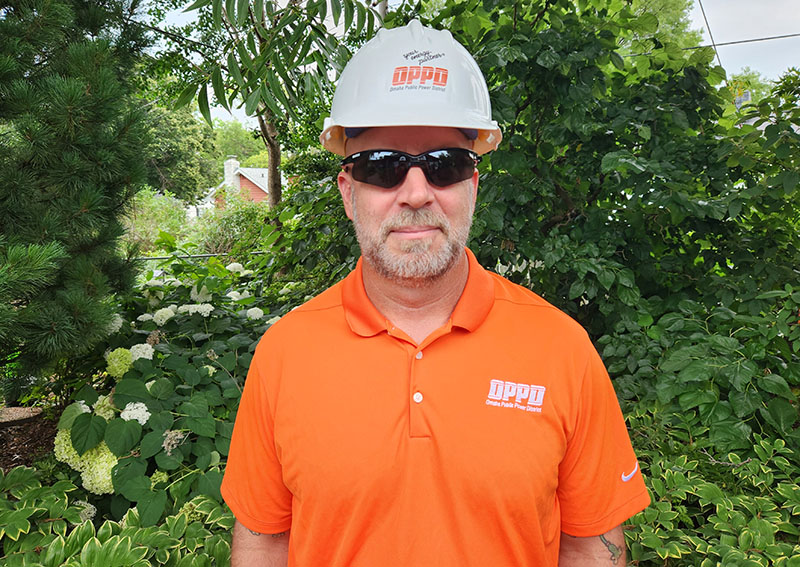
When big, gusty storms slam eastern Nebraska, falling tree branches can cause a lot of power outages.
That’s why OPPD employs a small, experienced team of specialists to identify overgrown areas that need trimming and oversee the tree crews that clear the way for power lines.
Utility foresters play a crucial, never-ending role in OPPD’s efforts to prevent and minimize outages. Their work requires technical skills, good communication, the ability to manage, and a willingness to work and empathize with local property owners who love their trees.
OPPD’s external tree crews, Asplundh and Wright Tree Service, help maintain 6,700 miles of overhead lines throughout eastern Nebraska. Approximately 60% of those lines have some sort of vegetation growing nearby. Those crews trim or remove more than 100,000 trees annually.
“We want to make sure we’re keeping the lights on for everybody,” said Wade Bliss, a utility forester who, like all of his coworkers, started his career on a tree crew contracted by OPPD. “We all know how frustrating it can be for our customers when they lose power.”
A common problem
Trees that grow into power lines are a common and avoidable problem throughout OPPD’s service territory. They’re potentially dangerous for homeowners, neighbors and the crews that work daily to ensure wayward branches don’t cause an outage or start a fire.
“Tree work is very dangerous,” Bliss said. “You’re working at heights, with a chainsaw, and around energized lines. Our guys do really good work and they’re really thorough. They have to be.”
Tree crews typically clear overgrowth between poles, while homeowners are responsible for the lines running from poles to the service connection on their home.
OPPD also needs access to padmount transformers – the big, trunk-shaped green boxes in yards – so it’s best to keep at least 5 feet of clearance around those.
Some homeowners understandably get frustrated when OPPD approaches them about their trees. Crews cut branches in ways designed to keep trees healthy, while clearing adequate space for power lines. Sometimes, that means removing large limbs.
Right tree, right place
Bliss preaches the importance of “Right tree, right place” when property owners want to plant something new.
Trees grow at different paces. Slow growers don’t need to be trimmed as often. Smaller and ornamental trees are a good choice. OPPD’s Arboretum offers some clearly labeled options that usually work well.
“You don’t want to plant a tree that will mature to a height of 40 to 45 feet near power lines,” Bliss said. “That becomes problematic.”
Homeowners tend to make two common tree-related mistakes near overhead lines, arborists say. One is trying to do dangerous jobs themselves, such as working at heights with a chainsaw. Often, it’s better to contact a professional.
The other is over-mulching, which can cause rot, decay and funguses that send trees into decline.
Bliss said homeowners should always look for signs of ill health, such as broken branches, large cavities, or brown and curled leaves that should look healthy and green.
If a branch falls on a power line, it’s important to stay away and contact OPPD immediately.
Becoming a utility forester
Most utility foresters start with a love of the outdoors. A willingness to learn is critical. Becoming an arborist requires study of water management, soil, and trees. Cut in the wrong place and a tree won’t heal properly, creating a bigger potential hazard. Good technique comes with practice.
“Trees are a wonderful asset to our environment, obviously, and the benefits are numerous,” Bliss said. “That passion is where a lot of folks start.”
Bliss previously worked at both Asplundh and Wright Tree Service in various roles. Along the way, he garnered certifications as an arborist and a utility specialist arborist through the International Society of Arboriculture.
“It’s not just cut and go,” Bliss said. “There’s a lot of science behind it. It’s many years in the field and a lot of hours studying.”
Safety first
Tree crews enforce vigorous safety protocols, with insulated tools and distance minimums from electrified equipment. Sometimes, they need assistance from an OPPD troubleshooter or line crew to de-energize a line so they can work.
“We don’t want to shut down a whole circuit just for one little span,” Bliss said. “We try to be as quick and efficient as we can. And we want to be respectful of the people who are being inconvenienced temporarily, but it really is a safety issue.”
Utility foresters and crews also keep watch for garden decorations, benches and any yard items that a falling branch could damage.
In the Omaha metro, foresters typically encounter six species: maples, oaks, elms, mulberries, hackberries and evergreens. Some residents have proactively treated ash trees to protect them from the dreaded emerald ash borer.
The right stuff
Tree trimming takes stamina and strength. Climbers ascend using specialized ropes, harnesses and hitches. Knot-tying and knowing where to place ropes are key. Other ropes hoist saws up within reach and help lower large branches in a controlled manner. An errant branch could hit a power line or property.
“We want to have control, and an uncontrolled branch can do all sorts of things,” Bliss said. “You can’t just cut it and let it tumble.”
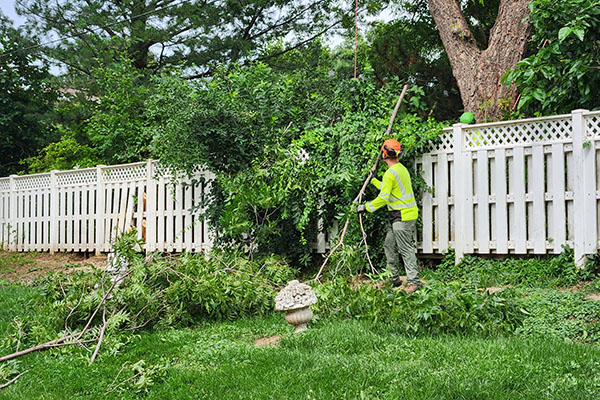
Technology has evolved to make the work slightly less physical, reduce injuries and help prolong climbing careers, but it’s still a challenge.
During major storms, utility foresters mobilize and send tree crews out with line technicians to tackle work together. For smaller events, utility foresters remain on call and can dispatch crews as needed.
New technology
As technology evolves, so does OPPD.
The utility now uses artificial intelligence and satellite imagery to map the distance between trees, lines and poles. That technology helps OPPD prioritize areas with lots of overgrowth. Line maintenance technicians, electrical service designers and others in the field provide feedback as well.
OPPD aims to maintain an overall average trim cycle in the metro area of five years. Some circuits in the metro needs to be trimmed sooner than five years while others can wait a bit longer. Understanding which circuits those are, is where the technology and feedback help inform OPPD’s Vegetation Management Program. The utility also looks at neighborhoods where customers have experienced frequent outages to see if certain areas need more attention.
“There’s no shortage of work,” Bliss said. “We try to be as proactive as we can.”
Good choices
Utility foresters can’t just focus on the physical. The job requires people skills with both contractors and customers.
“You have to be multi-talented,” said Aaron Holloway, supervisor of Transmission and Distribution Maintenance Management. “We employ a lot of empathy when we talk to customers. We understand that it’s your property, your tree, and your view that is being impacted.
Holloway said OPPD’s contractors take extra care to ensure trees are trimmed following arboriculturally sound guidelines to promote good tree health after the work is complete.
Utility foresters may also have to work with electrical service designers or engineers and inspect sites in advance. They lead worksite briefings for crews and inspect areas for potential dangers.
“You can’t just run back there and jump in the trees,” Holloway said. “We have to make sure everybody goes home safe at night.”

Grant Schulte joined OPPD as a content generalist in 2022. He is a former reporter for The Associated Press, where he covered the Nebraska Legislature, state politics and other news for a global audience. He is a graduate of the University of Iowa and a proud Hawkeye. In his free time he enjoys running, reading, spending time with his wife, and all things aviation.
View all posts by Grant Schulte >