Energy news from Omaha Public Power District
Energy news from Omaha Public Power District
New budget and rates proposed to accommodate reliability, growth
OPPD unveiled a new $3.4 billion operating budget on Tuesday to accommodate record demand for electricity, new infrastructure needs to support reliability and sharply higher costs.
The 2027 budget, known as the Corporate Operating Plan, includes a 3% rate increase for residential customers, or $3.45 on an average $115 bill. Some customers may see more or less than these amounts, based on their usage. Customers with high usage could see higher increases, while customers who use less might see a lower impact.
Utilities nationwide are facing similar cost pressures, although OPPD has held rates well below both the national and regional averages.
OPPD’s retail rates this year were 30.2% below the national average and 12.1% below the regional average.
OPPD leaders worked diligently to minimize the impact through careful budgeting and a cost-of-service model that prioritizes fairness, pricing stability (minimizing big swings), efficiency (encouraging smart energy use) and cost causation (customers paying the costs that their usage creates).
“Preserving reliability and affordability are the keystones of public power, and we worked very hard to mitigate the impacts on our customer-owners,” said OPPD Chief Financial Officer and Vice President of Finance Brad Underwood. “We don’t take these proposals lightly. We focused on striking a balance between maintaining competitive rates and meeting critical infrastructure needs.”
Record demand, rising costs
The new rates would go into effect on Jan. 1 if approved by OPPD’s Board of Directors in December.
OPPD logged record-setting demand again this year, with a new winter peak of 2,414 megawatts in January and 3,285 megawatts in July. OPPD has broken at least one load record every year since 2019 and has added 30,000 new customers in that time. Nebraska also ranks as the seventh-fastest growing state for customer demand, based on an annualized growth rate – and OPPD’s annualized growth rate is even higher.
The utility is in the midst of a monumental buildout to support that continued growth. That buildout includes 400 miles of new transmission over the next decade, two power station expansions, 425,000 modern meter installations and four new solar/wind/storage agreements.
Inflation has driven up material costs for all utilities. Copper prices are up 104% now compared to 2020, machinery has risen 91%, cement is up 48% and steel is up 57% during that timeframe.
Wait times for key equipment have grown as well. Power transformers that took around a year to acquire in 2021 now take 2 ½ to almost five years. Other types of transformers, switchgears and connectors now see similarly large wait times.
Because of those industry-wide cost pressures and the need to keep growing to serve all customers, some rate increases are likely for the foreseeable future.
Commercial customers will see an average increase of 5-6% next year, although that too will vary.
Some commercial and industrial customers could see larger rate impacts this year due to new applicability standards approved by OPPD’s board in December 2025. Of the 3,411 commercial customers who were moved to that new rate, about one-third will see an increase greater than 10%. OPPD has worked over the last year to share that news with the affected customers in advance.
Industrial customers that use huge amounts of electricity will see an average increase of 13%.
Setting rates
OPPD uses what’s known as a cost-of-service model to set rates.
The utility first calculates the cost to operate reliably and safely, including all generation and purchased power, transmission and distribution, maintenance and upgrades, customer service and operations, and regulatory requirements.
Then OPPD divides those costs among different customer groups (residential, commercial and industrial) based on how much energy they use, when they use and the infrastructure necessary to serve them.
OPPD also maintains a variety of programs, including the Energy Assistance Program, level payment billing and weatherization support for customers who might struggle to pay their bills.
The utility recently partnered with Google, United Way of the Midlands and a variety of area community partners to strengthen community resilience. A $6 million contribution from Google will help support weatherization and efficiency programs, as well as workforce development, community projects focused on resiliency and direct support for individuals and families experiencing a high energy burden.
“We know any increases are difficult for customers who are already struggling financially,” said Chief Customer and Public Engagement Officer Tim McAreavey. “We have a number of programs to help, such as energy assistance, budget billing and weatherization assistance; we want customers to reach out before they fall behind.”
Careful budgeting
To mitigate as much of the rate impacts as possible, OPPD prioritized spending in areas where it’s most needed and delayed other expenses. The utility paused construction on a planned new operations center. It also held operating and maintenance expenses flat while protecting crucial generation, transmission and distribution investments that will support reliability and growth for all customers.
OPPD is in a strong position financially due to prudent budgeting and a focus on long-term strength. The value of its physical assets – plants, poles, substations and other electrical equipment – is up 68% from 2020. The value of total assets is up 73%, and electric energy sales are up 41%. OPPD’s net position (equity) is up 64% in that time window.
The utility maintains a disciplined, conservative approach to its budget. OPPD has two times its debt service coverage, meaning that OPPD has double the cash flow needed to cover its debt obligations including principal, interest and lease payments.
OPPD is also maintaining at least 230 days’ worth of cash on hand to help ensure it can meet its financial obligations.
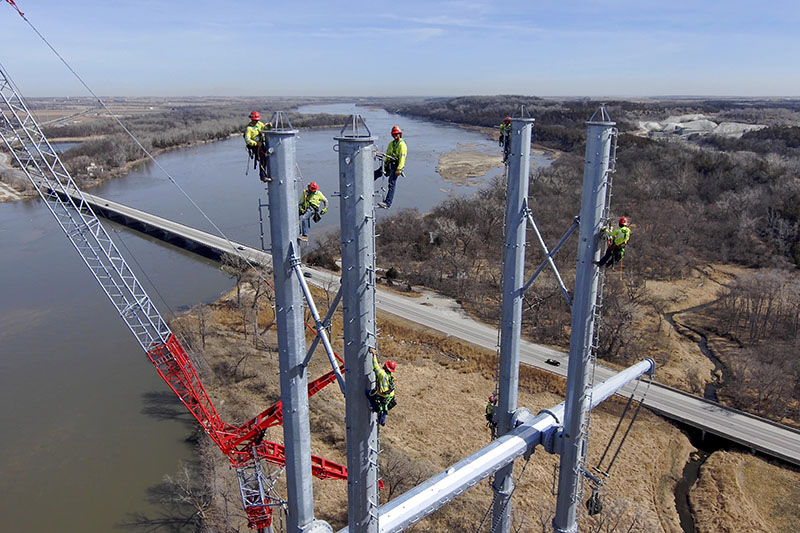
Recent buildouts include new transmission towers in Louisville, the tallest in OPPD’s history, and the widest transmission foundation in the district at 14 feet, requiring continuous pours from 40 concrete trucks. OPPD managed six heavy hauls to support turbine and generator deliveries, with more to come.
On the operations and maintenance side, key growth drivers include generation fleet expansion, which requires more workers. OPPD also expects to add more money for tree-trimming and Southwest Power Pool (SPP) fees related to transmission growth.
Fuel and purchased power expenses are also projected to be $120 million higher than in 2026.
To smooth any retail rate changes, OPPD is building reserves in advance of commercial operations at Cass County and Turtle Creek Stations. That smoothing now will help mitigate future rate increase in a predictable, stable way.
OPPD is likewise making investments to harden infrastructure, enhance its customer platform and outage map, and adopt modern advanced metering infrastructure meters.

Grant Schulte joined OPPD as a content generalist in 2022. He is a former reporter for The Associated Press, where he covered the Nebraska Legislature, state politics and other news for a global audience. He is a graduate of the University of Iowa and a proud Hawkeye. In his free time he enjoys running, reading, spending time with his wife, and all things aviation.
View all posts by Grant Schulte >