Energy news from Omaha Public Power District
Energy news from Omaha Public Power District
Next round of advanced meter installations begins soon
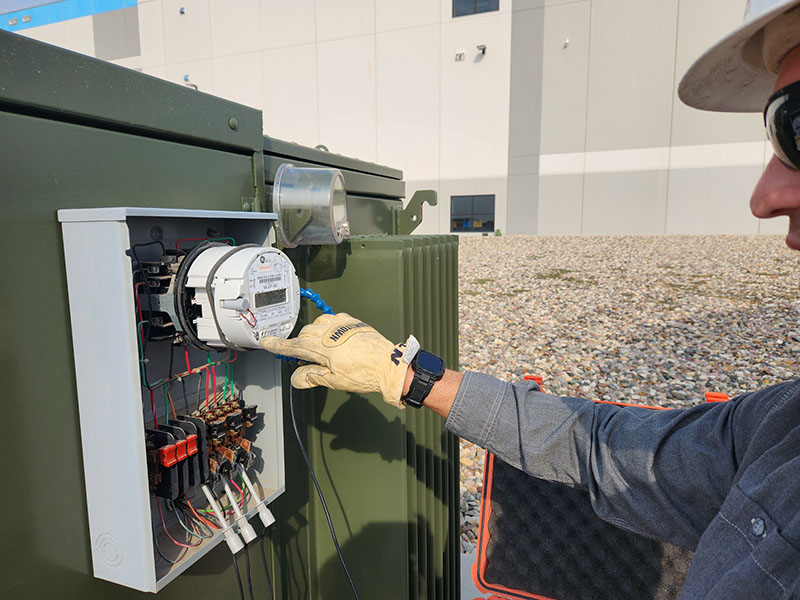
Large customers in the rural southern half of OPPD’s territory will soon get new and more advanced electrical meters as part of the utility’s rollout of new technology.
Starting in September, OPPD meter technicians will be installing current-transformer (CT) rated and larger self-contained meters in rural areas between Omaha and the Kansas border. Those meters are part of OPPD’s district-wide upgrade to advanced metering infrastructure (AMI).
Those types of meters serve bigger customers, including factories, major convenience stores, farmhouses with barns and large sheds, and other sizable buildings.
AMI is a collection of modern technology that will allow direct, two-way communication between the utility and individual customer meters. Utilities including Nebraska Public Power District and many others nationwide have already adopted the technology, with good results.
Many of those meters will connect to OPPD through highly secure cellular networks. During outages, those meters will proactively notify OPPD so crews can start rolling sooner (though it’s still a good idea to report outages yourself, at least for now).
Meter technicians will install about 30,000 meters in the southern half of the district.
“Everyone here is lining up and chomping at the bit,” said Mike Iwanski, OPPD’s manager of AMI Transformation. “We’re ready to go and start sending people out to do the work.”
More information for you
The new meters will offer customers faster and more precise outage information, a more detailed picture of their energy usage and other helpful tools.
OPPD has installed about 12,000 meters so far in different areas, both urban and rural, with a mix of residential, commercial and industrial customers.
Districtwide, OPPD intends to install roughly 420,000 new AMI meters with help from a contractor, Allegiant, which is handling most replacements in the Omaha metro.
OPPD intends to complete all work by the end of 2028, with final testing for reliability anticipated in early 2029, barring unforeseen developments.
Building a network
OPPD relies on a field area network (FAN), or mesh system, in much of the Omaha metro to communicate with individual meters. Rural areas make greater use of cellular networks to transmit data back to OPPD. Both systems contain redundancies to ensure secure, reliable communication.
Meters can also send signals to other meters as a sort of pathway for transmitting data back to OPPD’s gateway portal.
The Omaha area’s mesh communication system uses a combination of fiberoptic cables through substations, and in some cases cellular towers. All information funnels into a gateway, the hub where data enters OPPD’s system.
Larger CT-meter customers generally shouldn’t notice any outages when meter technicians replace their units. CT meters are connected in parallel with the incoming services, which allows meter technicians to exchange a meter without disconnecting that customer’s service. Meter technicians will conduct special field checks to ensure everything is functioning properly.
New tools
With their new AMI meters, businesses and homeowners alike can see their usage and potentially help identify ways to operate more efficiently. All those preferences are available on MyOPPD.
Iwanski said OPPD is communicating proactively with every customer – residential, commercial and industrial – to make them aware of the upcoming meter swaps. OPPD’s current automated meter reading (AMR) meters are about 20 years old, well past their suggested 15-year lifespan. AMR meters also require in-person, neighborhood drive-bys to collect data.
“We needed to exchange these meters one way or another,” Iwanski said. “This is going to give us that new technology that will help OPPD and our customers.”
MyOPPD offers a variety of benefits, including outage notifications, bill updates, guest access, usage tracking, plus customer and streetlight outage maps.
“It allows people to do some self-examination of what’s going on with their usage,” Iwanski said. “But the one I’m most excited about is outage detection.”
When customers with AMI meters lose power, OPPD is automatically notified about the outage (though for now, it’s still a good idea to report your outage via phone, OPPD’s website or the MyOPPD app). That faster warning allows OPPD to dispatch a repair truck sooner.
“We’re already seeing the benefits from the new AMI meters that we’ve already installed,” Iwanski said. “There have been a few outages where customers hadn’t even called yet, and we were already out there fixing their problem. It’s exciting to see that.”
A broader picture
On a larger scale, meters that lose power during major storm could give OPPD a sense of the damage footprint and the outage’s size.
“It could give us some better visibility into the outage and potentially help with our predictions of storm restoration times,” Iwanski said.
Iwanski stressed that the new meters are secure, safe, accurate and already well-tested by many other utilities throughout the United States. The meters rely on power from the lines running to your house, but that usage isn’t counted on customer bills.
“This is just another way that we’re working to serve our community,” Iwanski said.

Grant Schulte joined OPPD as a content generalist in 2022. He is a former reporter for The Associated Press, where he covered the Nebraska Legislature, state politics and other news for a global audience. He is a graduate of the University of Iowa and a proud Hawkeye. In his free time he enjoys running, reading, spending time with his wife, and all things aviation.
View all posts by Grant Schulte >