Energy news from Omaha Public Power District
Energy news from Omaha Public Power District
OPPD board approves 2026 budget, rate proposal to support reliability
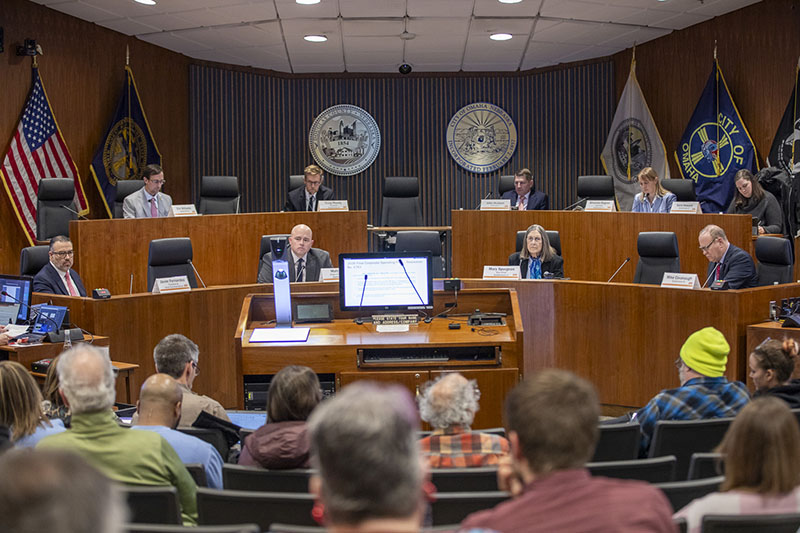
OPPD’s board of directors on Thursday approved a new budget proposal to help keep pace with surging demand for electricity, rising costs and new regulations that will require even more generation.
The $2.98 billion 2026 Corporate Operating Plan (COP) paves the way for crucial infrastructure investments needed to maintain reliability and serve the enormous load growth in every customer class in OPPD’s service territory.
It also follows standard industry practices to promote fairness, stability, efficiency and transparency for every customer class. The COP helps ensure that customers pay based on how much energy they use, when they use it and the infrastructure that’s needed to serve them.
To help manage rising expenses, the COP recommended a 6.3% average rate increase for all customer classes. The increase is composed of a 5.8% average general rate increase and a 0.5% increase to the Fuel and Purchased Power Adjustment (FPPA) factor, a line item on bills.
OPPD’s rates are still lower on average than most other utilities. As of 2024, OPPD’s average retail rate was 30.2% below the national average, according to the U.S. Energy Information Administration. Preliminary numbers indicate that the 2025 rates are also 30.2% below the national average.
‘Reliable, affordable energy’
“Maintaining reliable, affordable energy for everyone and managing costs is our top priority, and this Corporate Operating Plan helps strike that balance,” said OPPD President and CEO Javier Fernandez. “We are doing everything in our power to be good financial stewards and minimize any impact on our customer-owners.”
On average, residential customers will see a 6% increase, or about $7 on a $115 bill. Commercial customers will see an average increase of 3.7%, while industrial customers will see an average increase of 8.9%. Each customer class has several rates available to them, so customers may see more or less of these amounts depending on their specific customer class rate.
The new rates go into effect in January.
Rising costs
Soaring prices for steel, copper and concrete have outpaced the consumer price index, a common measure of inflation. As a result, transformers, power lines, generators and other equipment all cost much more than they did just a year ago.
An industry-wide labor shortage is driving up costs and wait times as well. OPPD also faces new regulatory demands.
Starting in 2026, the Southwest Power Pool (SPP) will require OPPD and its other member utilities to maintain much larger energy reserves to ensure reliable power during extreme summer and winter weather. The SPP is a regional transmission organization. Its member utilities that buy and sell power to one another to ensure reliability and competitive wholesale prices throughout the central United States.
The new regulations will promote a reliable power supply but also require OPPD to build even more generation just to serve its existing customer load.
Unprecedented demand
OPPD is seeing unprecedented demand as Nebraska’s economy grows and relies more than ever on electricity. The utility has added 23,000 new meters over the past five years. That’s roughly the same number that serves the city of Grand Island.
New manufacturing, biotech companies, data centers, and food and agricultural processing all play a role, as does demand from residential customers. The more the system grows, the larger the reserve margin required by SPP.
“We believe this rate adjustment properly balances both the needed critical infrastructure to enable our community to grow and the rising cost of power as we strive to keep rates competitively low,” said OPPD Chief Financial Officer and Vice President for Financial Services Brad Underwood.
Managing the change
OPPD has already cut nearly $60 million in costs internally, with a hiring freeze for non-essential employees and a pause on certain major construction projects, including a planned Integrated Operations Center. Projects and maintenance work deemed non-essential were deferred or canceled. For context, $60 million in cost savings equates to an additional 4% in avoided rate increases.
The utility also offers assistance programs for low-income customers struggling to pay their bills.
The 2026 Corporate Operating Plan includes essential projects that directly affect customer service and system performance.
OPPD is working continuously to harden the grid against extreme weather, add new generation and build more infrastructure to help electricity flow efficiently to everyone who needs it.
The utility is adding four new natural gas turbines to its existing Turtle Creek Station and Cass County Station facilities. Those turbines will add 900 megawatts (MW) of capacity to the utility’s portfolio. The projects are part of OPPD’s work to add 2.5 gigawatts of power over the next decade.
The utility also plans to add 400 miles of new transmission lines over the next 10 years. It also expects to build 14 new substations and expand 25 existing substations. At the same time, OPPD is moving 20 to 40 miles of overhead distribution lines underground every year to help protect customers against storm outages.
Allocating costs
As a public utility, OPPD has the privilege and obligation to provide electrical service to anyone who requests it. The utility sets its rates using what’s known as a cost-of-service model.
First, OPPD calculates the cost to operate reliably and safely, including all generation and purchased power, transmission and distribution services, maintenance and upgrades, customer service and operations, and regulatory and reliability requirements.
Then the utility divides those costs among different customer groups (residential, commercial and industrial) based on how much energy they use, when they use it and the infrastructure necessary to serve them.
OPPD then designs rates that reflect cost causation (customers paying for what they use), fairness (preventing one customer class from subsidizing another), price stability (avoiding big price swings), efficiency (encouraging smart energy use) and transparency (sharing the process and rationale with the public).
The process helps ensure that “cost causers” are “cost payers” with their usage driving the rate they pay.
Progress made
Beyond the Corporate Operating Plan, OPPD celebrated major achievements over the last year with new technology and numerous large projects.
“As a public power utility, we’ve risen to the challenge to serve our customer-owners as efficiently as possible,” Fernandez said. “I’m proud of everything our team has accomplished, and we look forward to serving Nebraskans for generations to come.”

Grant Schulte joined OPPD as a content generalist in 2022. He is a former reporter for The Associated Press, where he covered the Nebraska Legislature, state politics and other news for a global audience. He is a graduate of the University of Iowa and a proud Hawkeye. In his free time he enjoys running, reading, spending time with his wife, and all things aviation.
View all posts by Grant Schulte >