Energy news from Omaha Public Power District
Energy news from Omaha Public Power District
OPPD makes big dent in streetlight outage backlog
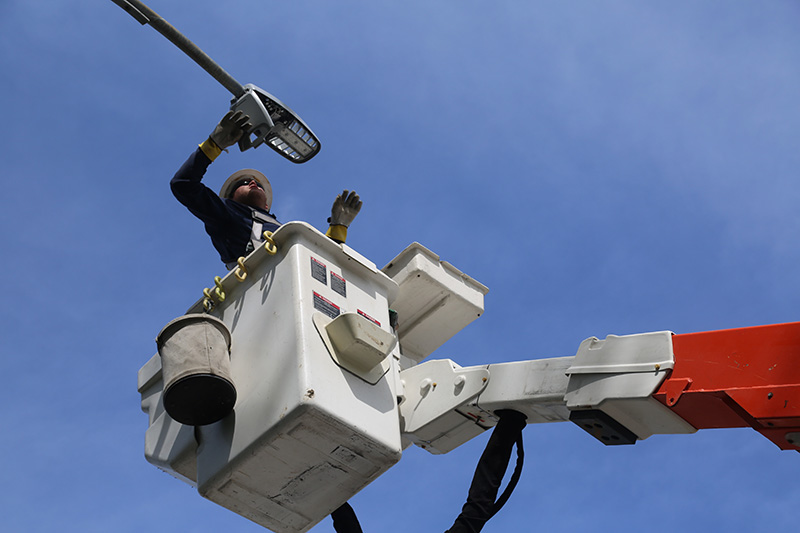
When streetlight outages repeatedly plagued a historic Omaha neighborhood this year, OPPD managers and field workers knew they needed to act.
For months, homeowners and businesses on Ames Avenue between 30th and 72nd streets dealt with annoying, on-and-off interruptions. Streetlights sometimes went dark for days on busy stretches of road, and customers were understandably upset.
The cause was multifaceted and part of a larger, metro-wide backlog. Major storms, aging equipment and communications companies hitting underground lines played a big role. Many streetlight poles stood right next to the road, making them more vulnerable to crashes. On Ames Avenue, one big, interconnected circuit would sometimes cause a single damaged pole to trigger many other outages, like old-fashioned Christmas tree lights.
“We were really struggling to make progress on our outage backlog, so we decided it was time to change our approach,” said Justin Robinson, a field supervisor who oversees OPPD’s streetlight workers.
Attacking the problem
After several months of concentrated effort and teamwork, OPPD has reduced its streetlight outage backlog to less than 600 total reports.
The work is by no means done, but Robinson said the team has made good progress and will keep pushing forward. The nine-member streetlighting field team continues to work overtime in a fast-growing metro with more than 115,000 streetlights.
“All the customers know is the light is out and it should be on, and they’re right,” Robinson said. “We understand that, and we want to get them fixed in a timely manner.”
OPPD attacked the problem with a combination of overtime for streetlight workers, a renewed focus on the hardest-hit areas, and additional support from contractors to handle more complex and time-consuming repairs. The utility also added streetlighters to its automated callout system, which is designed to dispatch workers quickly during urgent situations.
Additionally, OPPD recently unveiled a new online map where customers can self-report streetlight outages. Without customer reports, OPPD often doesn’t know that streetlights are out.
The new approach arose from a working group composed of multiple OPPD departments that sought to address the problem.
“We wanted to learn what the pain points were and see what we could do to become more efficient, to make us better,” Robinson said. “Were there areas where we needed a little help?”
Staying vigilant
OPPD’s backlog recently dropped to 556 known outages, the lowest rate in the last six or seven years.
Robinson said the utility is aiming to maintain a backlog of less than 700 streetlight outages at any given time. In 2025, the total was approaching 1,000, and the number spiked to more than 2,000 after a series of extreme storms in 2024.
“I think first and foremost, we’ve really improved our posture toward this work,” Robinson said. “We understand that we need to address these issues.”
Work on Ames Avenue
OPPD Streetlight crew leader Jose Maes took the Ames Avenue assignment to heart. With a fellow streetlighter, GIS technicians and engineers, he visited the neighborhood earlier this year to analyze the situation.
Before long, the group realized they could split streetlights that were connected on one circuit so that if one pole took a hit, at least some others nearby would keep shining. The team has since applied similar fixes to other busy Omaha roads.
“We made a concerted effort to split up that circuit into smaller groups so that it would minimize outages,” Maes said.
Robinson credited OPPD’s forestry crews for helping to clear trees along Ames Avenue, which should help reduce future storm outages.
OPPD is also keeping close track of outages so they don’t get lost in the shuffle of other customer work.
“Customer expectations are high, and it’s understandable,” Maes said. “If you’re an elderly person living on a busy street, it’s a safety issue. Having your streetlight on is a big deal.”
Enlisting contractors
For years, Shelby Reeker added a simple tagline to her OPPD work email: “Streetlights are there for safety. Safety is the reason for the lights.”
The message, sent by a customer years earlier, still guides her daily work as a construction services coordinator. Among other duties, Reeker schedules larger and more complex streetlight repairs that require an outside contractor.
“I wanted people to know I’m passionate about streetlights,” she said.
One factor behind streetlight outages is telecommunication companies boring into the ground to bury cable. Streetlight wires tend to be 18 to 24 inches below ground. Other utility lines lie beneath that space, including fiberoptic cable and gas and water lines. Without proper care, workers can easily puncture underground streetlight wires. That’s why you should always call 811 before digging to avoid hitting lines.
“We rely on customers to call in outages,” Reeker said. “And a lot of times, these companies don’t know that they’ve hit a line. So we may find out weeks or even months after the fact.”
Reducing storm backlogs
During storms, streetlighters work on OPPD’s wires-down team, which focuses on assessing downed power lines before line crews arrive, moving trees and debris, and restoring electricity to individual customers when possible (for example, when a fallen tree rips a service line off a home).
Historically, the wires-down team has included meter technicians and streetlight workers. But now that team has expanded to include substation workers in hopes that the extra support will allow streetlight workers to turn their attention back to streetlights sooner.
A new tool
OPPD has also unveiled a new streetlight outage reporting tool available on the MyOPPD app and at MyOPPD.com.
“We might see a huge spike in our workload once people realize how easy it is and start reporting problems,” Robinson said. “But that’s a good thing. We want to know about these problems so we can fix them.”
Robinson said OPPD is adapting to changing customer expectations.
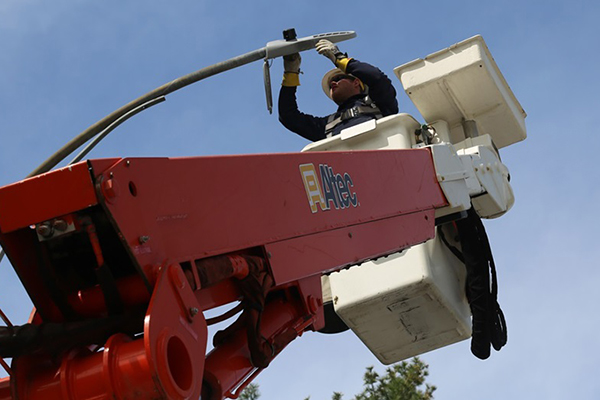
“We try to pay attention to cues like that from the public, especially if it makes things safer,” Robinson said. “But I want to emphasize, that doesn’t mean we’re letting our guard down. We’ve got to stay on top of it and keep momentum going in a positive direction.”
The number of outages has fluctuated over the years, but the recent change in approach seems to be working well, said Blaine Peterson, supervisor of Transmission & Distribution Contractor Support Services. Peterson said there’s always a big push to fix poles before winter hits and the ground hardens.
“It gets the backlog down and then things calm down,” Peterson said.

Grant Schulte joined OPPD as a content generalist in 2022. He is a former reporter for The Associated Press, where he covered the Nebraska Legislature, state politics and other news for a global audience. He is a graduate of the University of Iowa and a proud Hawkeye. In his free time he enjoys running, reading, spending time with his wife, and all things aviation.
View all posts by Grant Schulte >