Energy news from Omaha Public Power District
Energy news from Omaha Public Power District
Towers and cable: These specialists help keep OPPD connected
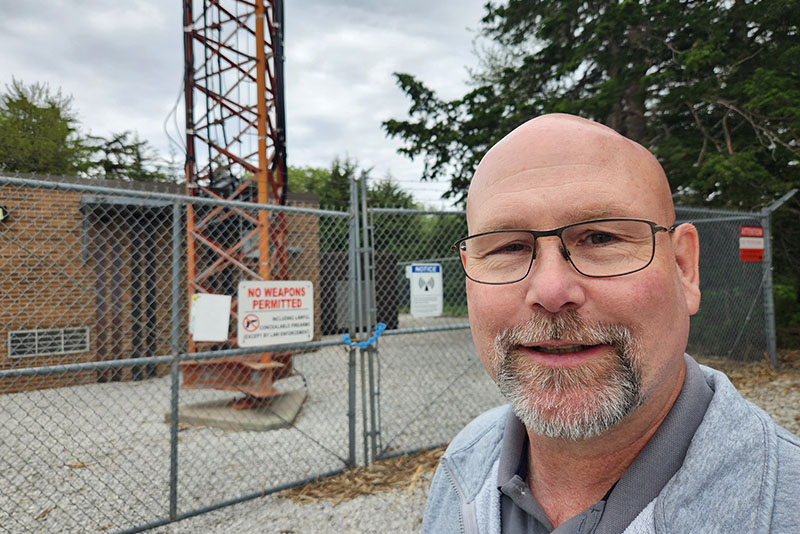
A few days after a big storm, Dan Weis rolled up to a radio tower on a quiet gravel road in Saunders County.
His mission: Check for broken lights, fallen trees and any other damage to the massive, 485-foot tower, which ensures reliable radio communication for hundreds of OPPD field workers. Towers, after all, take a lot of abuse. During one six-hour stretch of storms, lightning hit a single tower 97 times.
“They get hit all the time,” said Weis, a telecommunications team leader at OPPD. “They’re the highest thing in the area. But they’re designed to take it.”
Behind every field and plant worker at OPPD is a specialized engineering team that helps inspect, maintain and troubleshoot problems inside the utility’s vast, in-house communication network.
Telecommunications engineers oversee virtually all facets of the radio and fiber-optic technology that helps OPPD employees talk to one another, protect critical infrastructure, and monitor and control equipment remotely. They work in close partnership with telecommunications technicians, who execute most of the hands-on work.
“That’s the really enjoyable part: solving problems and working with the people who implement the solutions,” Weis said.
Towers and cable
Traditional radios connect far-away line crews, troubleshooters and many other specialists via “repeater” towers, which extend the reach of their signals.
OPPD owns and maintains 28 towers throughout its service territory, as far north as Blair and as far south as Barada, near the Kansas state line. Some are self-supported, others rely on guy wires. Four of them stand taller than 400 feet.
OPPD’s equipment shares space at some towers with Douglas, Washington, Dodge, Sarpy and Pottawattamie (Iowa) counties for their 911 systems and other critical functions. Nebraska state government participates as well, and Saunders County will join soon for redundancy in communications and to share maintenance costs.
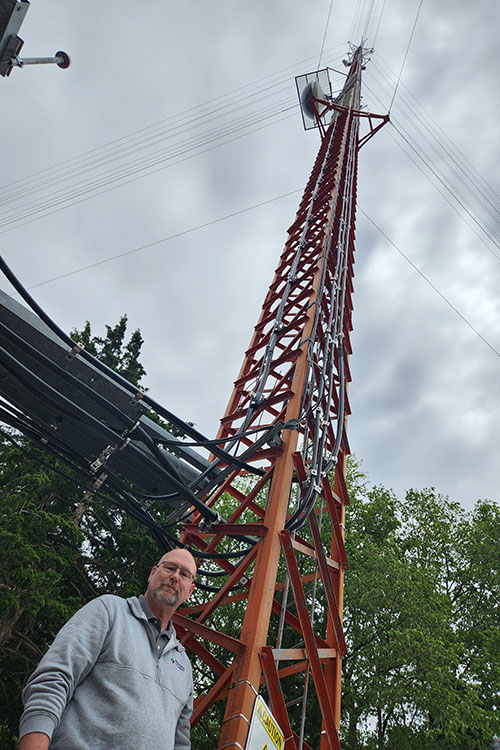
Meanwhile, fiber-optic cable lines ensure secure, reliable communication between substations, power plants, energy marketers and Energy Control Center (ECC) dispatchers who oversee the local grid. OPPD maintains 621 miles of overhead optical ground wire, which serves as both a communications line and a grounding source for power lines. The utility also owns 200 miles of underground fiber cable.
OPPD’s substations send a never-ending flow of information to ECC via high-speed fiber-optic cables. A few rural substations use point-to-point microwave sites – small radio transceivers affixed to poles – to communicate without cables.
Monitoring the system
Those connections allow ECC staff to monitor how much power is flowing through lines and open or close a breaker remotely – an important failsafe that protects the public, OPPD workers and millions of dollars’ worth of equipment.
“It’s basically their eyes for what’s going on in the substations,” said Mike Honaker, lead telecommunications engineer who works on OPPD’s fiber-optic technology.
For sensitive areas, OPPD uses secure and reliable connections with no ties to the internet or other outside sources. Connections are required at various facilities for employee badge readers, cameras and other security equipment.
Telecomm engineers also play a big role in advanced metering infrastructure, a new network that will provide more precise information to customers about outages and their electricity usage.
Always moving
Telecommunications is always changing as technology evolves, so the team must adapt.
“The work changes pretty much every day,” Honaker said. “That variety is definitely a lot better than working on the same bench all the time. You might be working in an office one day, and then you’re out in a remote location. You don’t get bored doing the same thing.”
That work comes amid huge and growing demand for electricity. Honaker remembers a time when OPPD was doing about three or four substation projects per year. Now, he sees more like 15 to 20 substation projects annually.
“It has definitely picked up,” he said. “There are so many projects coming from so many different directions, all the time. And you’re playing a part in making it all work.”
Technical backgrounds
Telecommunications engineers come from a variety of backgrounds. Some served in the military or worked for other utilities or communication companies. Some are freshly minted engineers. An interest in the technology is key.
“You can learn a lot just by gaining experience,” Weis said. “You’ve got to have an interest in it, and the earlier that starts, the better.”
Before he joined OPPD in 2006, Honaker worked in telecommunication roles at Nebraska Public Power District, Kinder Morgan Pipeline and the U.S. Air Force. He went to Southeast Community College to study in an electronic engineering technology program.
As a technician at OPPD, he went to Bellevue University for a degree in IT operations management, where he learned about conflict resolution, breaking bigger problems into smaller ones and the importance of good communication. He uses that now to train others.
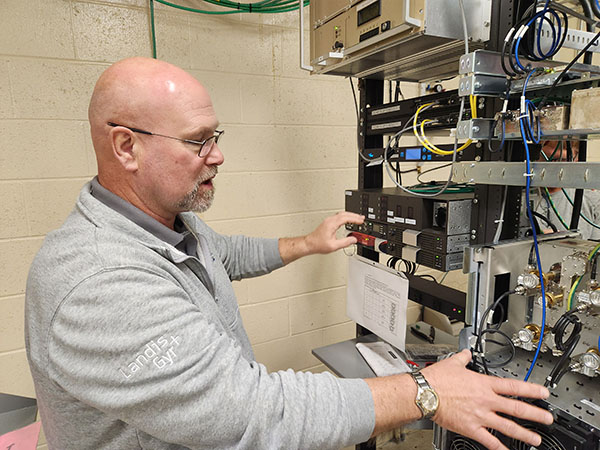
“It’s fun to develop new people,” Honaker said. “Coaching someone and then seeing them succeed is very rewarding.”
Weis started in the Civil Air Patrol in his native Wisconsin, sparking an interest in radio operations that lasted through high school and the Milwaukee School of Engineering, where he majored in electrical engineering.
From there, he joined a large wireless corporation in Illinois, then transferred to Omaha. He jumped to a few other companies before joining OPPD.
“Every day, we learn something new,” Weis said. “As engineers, we’re looking down the road. We’re developing project systems, maintaining those systems and determining what pieces and parts are necessary.”
Close collaboration
During site surveys, Weis checks dozens of potential issues. Does a tower have adequate rack space? Are the right cards in the chassis? Are all the channels available and operating properly? Are the power systems functioning properly? Is the surrounding security fence in good condition?
“I’m looking for preventative maintenance issues,” Weis said. “It may be that we haven’t caught it yet, or there may be something that just failed. Either way, we can get somebody out there to fix it.”
Telecomm engineers consult with one another all the time.
“We’re always exchanging information back and forth,” Weis said. “We collaborate with our telecommunications technicians in the same way. They have that nuts and bolts experience. I can sit there and specify parts for a project and they may say, ‘No, that’ll break over time. You want this piece instead.’”
Troubleshooting
A few months ago, workers at OPPD’s Cass County Station were having a problem.
In one corner of the plant, radios didn’t seem to work. Reception was poor and no one could figure out why. For the workers who help generate electricity every day, good radio communication is a must. OPPD maintains 1,457 portable and mobile radios for employees.
Fortunately, the fix was simple. After some research, telecommunications engineers decided to install a new antenna on a nearby tower, and the problem went away.
“It’s just a matter of getting coverage everywhere,” Weis said. “If there’s one very specific dead spot, we try to find a good cure for it without breaking the bank.”
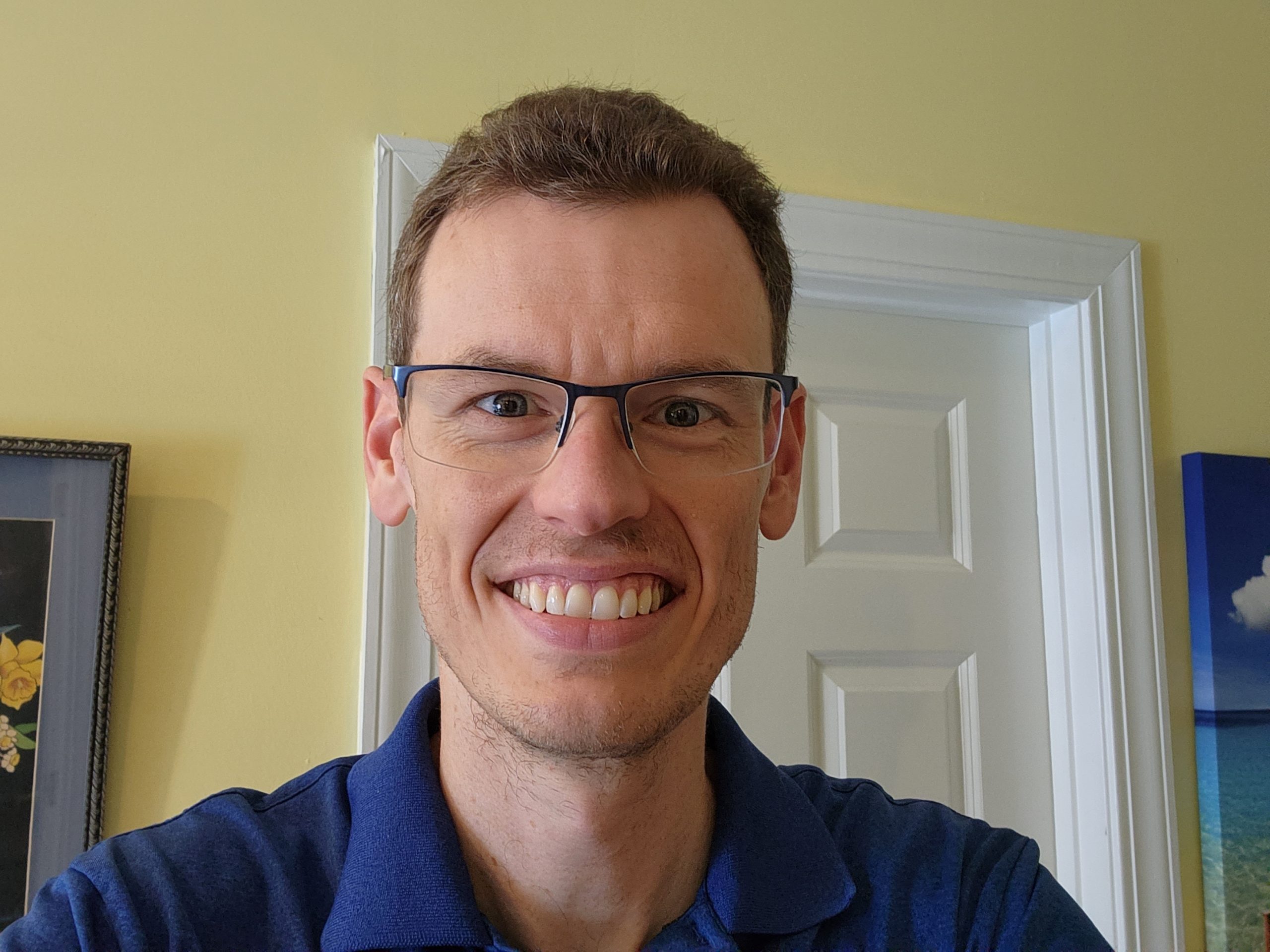
Grant Schulte joined OPPD as a content generalist in 2022. He is a former reporter for The Associated Press, where he covered the Nebraska Legislature, state politics and other news for a global audience. He is a graduate of the University of Iowa and a proud Hawkeye. In his free time he enjoys running, reading, spending time with his wife, and all things aviation.
View all posts by Grant Schulte >