Energy news from Omaha Public Power District
Energy news from Omaha Public Power District
Big upgrades are underway at OPPD’s Cass County Station
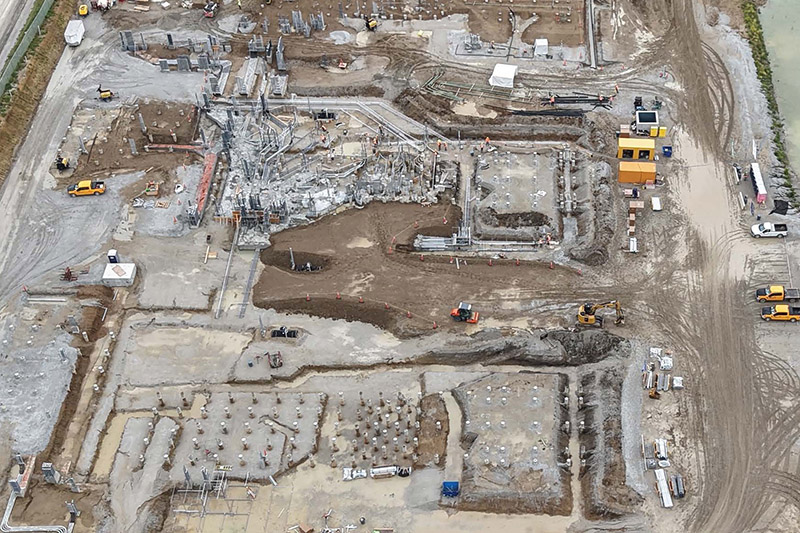
Major upgrades are moving along swiftly to add much-needed generation at OPPD’s Cass County Station and expand the capabilities of the plant’s existing units.
The ongoing project calls for three new, state-of-the-art natural gas turbine units and the retrofitting of the plant’s two existing units so they can use different types of fuel. The upgrades will give OPPD more flexibility in its operations at the plant southwest of Plattsmouth.
Crews are preparing to convert the two current natural gas units into dual fuel turbines, allowing them to use either natural gas or fuel oil.
Newly installed tanks are ready to receive fuel. A fresh foundation was poured for one of the new generators. Workers have dug trenches for pipe and electrical lines, and new buildings are going up for water treatment, fuel oil treatment and maintenance.
“It’s been a very challenging project, but very rewarding,” said Andrew Meusch, OPPD’s program manager for Generation Projects. “The overall pace that these projects are moving at is remarkable.”
A vital job
Cass County Station plays a big role in OPPD’s efforts to provide reliable, affordable and environmentally sensitive energy throughout eastern Nebraska while supporting the larger regional grid.
The plant will also help maintain the smooth, efficient flow of power within the central United States. Its value and easy access to fuel sources are more important than ever as OPPD adds new transmission lines and towers to support the grid. The plant will serve as a key connection point along OPPD’s Cass to Sarpy and Cass to Nebraska City transmission lines.
“It’s really about being able to serve customers and recognizing the need for both new generation and transmission infrastructure,” said Danielle Cram, OPPD’s program manager who is overseeing the construction work.
The dual fuel conversion is tentatively set for the end of this year and will require temporary unit outages to allow the work. Adding the fuel oil option will let OPPD operate the generators with fewer interruptions, even when natural gas supplies are low or prices are higher.
“The dual fuel conversion gives us greater fuel diversity,” Meusch said.
Crews are replacing turbine burners on units and adding new pipes, pumps, control upgrades and other key equipment.
Cass County Station’s current turbines each generate about 160 megawatts, while the three new units will each produce 225 megawatts, for a total of 995 megawatts once the work is complete.
Good dance partners
OPPD is moving forward via a partnership with Kiewit, which is providing engineering, construction and procurement services for the project, and Burns & McDonnell, a strategic partner helping to manage and track the work and ensure that all processes are followed correctly. Burns & McDonnell is also supplying extra on-site engineers to augment OPPD’s team.
OPPD secured Burns & McDonnell via a long-term agreement designed to ensure an adequate workforce and supplies when needed. That’s critical as more utilities compete for resources to meet their customers’ needs.
“It’s basically locking down a dance partner,” Meusch said.
All the progress comes as OPPD navigates supply-chain challenges that have made certain parts harder to get. Such projects require all kinds of controls, communication and coordination within the utility.
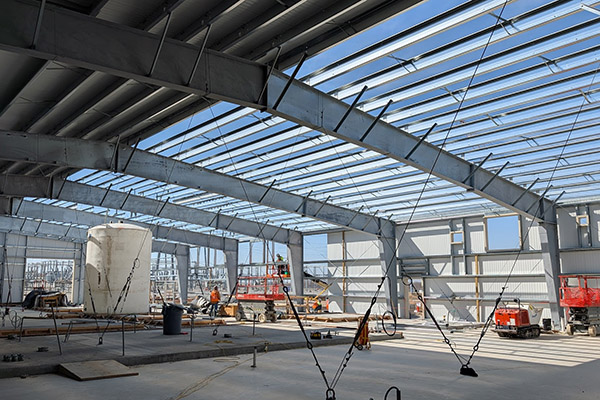
Like a giant puzzle, the project includes a lot of individual parts that require careful coordination. Slowdowns in one area can affect other pieces.
“It requires a lot of maneuvering,” Cram said. “How do we continue to sequence things to make sure we’re getting done what needs to be done and following up with those things that may be a little less critical?”
The on-the-ground team includes civil, structural, mechanical and electrical engineers who are ensuring the project meets its requirements and carefully tracking all costs and deadlines.
Cram said the team is actively documenting lessons learned from the work so that OPPD can apply that knowledge to future projects.
“We want to make sure we’re getting input from all of our partners and stakeholders to help us prepare for future projects,” she said.
The bigger picture
The upgrades come as the Southwest Power Pool (SPP) ramps up its planning reserve margins to ensure resilient, reliable power throughout its vast, 17-state region in the central United States.
Effective this year, OPPD and other SPP member utilities must maintain enough generating capacity to meet their peak projected consumption, plus an additional 36% planning reserve margin in winter and a 16% margin in the summer.
Planning reserve margins represent the amount of power utilities must keep available beyond their peak projected demand to guard against stresses on the regional power grid, including extreme weather. Bringing the new dual-fuel units online will help OPPD meet that demand.
The extra margin, combined with enormous local demand growth, is driving the need for more electricity. The work also means a lot of heavy hauls with large trucks to move large pieces of equipment along Nebraska roads and into position.
“We’re continuing to work on these projects to serve our customers’ needs,” Meusch said.

Grant Schulte joined OPPD as a content generalist in 2022. He is a former reporter for The Associated Press, where he covered the Nebraska Legislature, state politics and other news for a global audience. He is a graduate of the University of Iowa and a proud Hawkeye. In his free time he enjoys running, reading, spending time with his wife, and all things aviation.
View all posts by Grant Schulte >