Energy news from Omaha Public Power District
Energy news from Omaha Public Power District
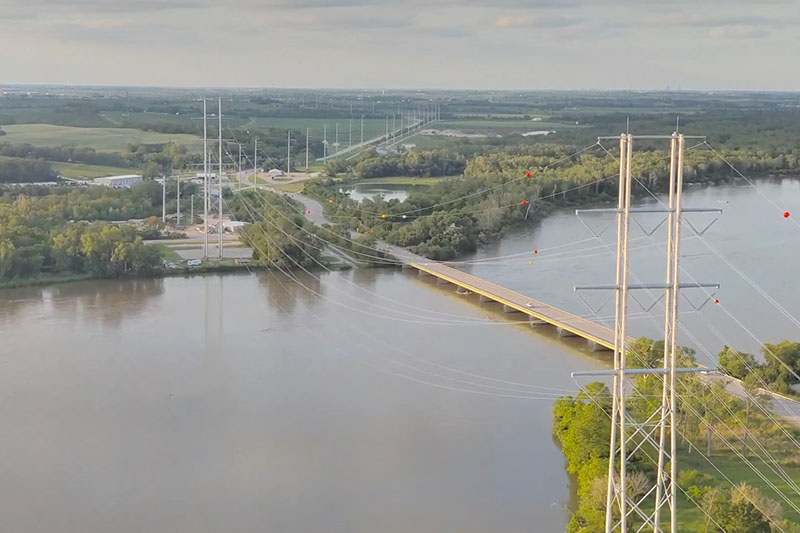
A new, 23-mile high-voltage transmission project is taking shape in some big and impressive ways.
Workers recently completed a half-mile stretch of the route across the Platte River in Louisville. New towers – the largest in OPPD’s service territory – are now holding a 345-kilovolt (kV) line in place over both sides of the river, along with a 69-kV line and a lower-voltage distribution line.
That work marks a major milestone in the Cass to Sarpy Transmission Project, an effort to ensure redundant, resilient and reliable power for generations to come.
The 345-kV line will connect OPPD’s Cass County Station to the recently completed Turtle Creek Station in Sarpy County. That pathway will help transmit electricity more efficiently through both Nebraska and the larger regional grid, from North Dakota to Texas.
Transmission networks are similar to an interstate highway system, channeling huge amounts of energy over long distances.
“I’m glad to see this project coming to fruition after many years of planning and preparation,” said Mohammed Amrollahi, lead transmission engineer at OPPD.
Big and practical
The new towers stand 347 feet tall and about 2,500 feet apart. Typical transmission structures are roughly 850 feet apart.
Their extra height, thickness and strength help support upgraded, heavier lines; provide more space between each line set; allow for more wire sagging between the towers; and fortify the whole system against extreme weather. These structures are engineered and tested to harden the grid by withstanding wind speeds up to 150-175 mph.
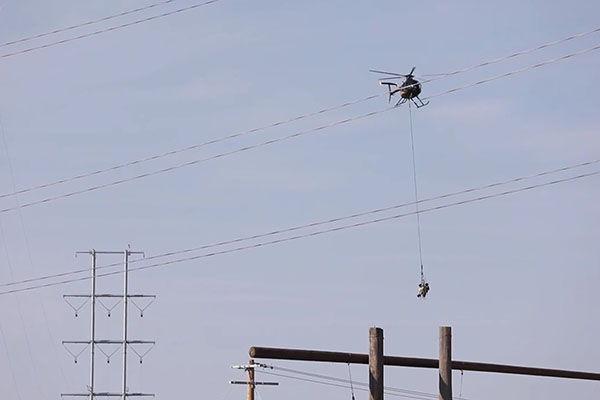
Workers used a helicopter to string the lines across the river and hang them on the structures.
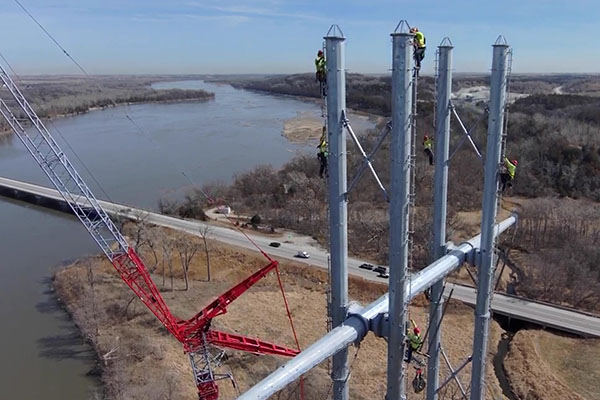
The towers are also built to accommodate later upgrades, a big advantage over the next 15-20 years as OPPD continues to build. The previous towers held just a single, 69-kilovolt transmission line and a lower voltage distribution line.
“This helps ensure we’re ready for the future,” Amrollahi said.
Each tower has four foundations, for a total of eight that extend 100 feet deep into the soil and bedrock along the river.
Contractors filled each foundation hole with slurry, a synthetic gel that stiffens the hole’s inner walls to keep it from collapsing during construction. Then they inserted tube-shaped steel rebar cages to reinforce the foundations and installed each structure.
Years in the making
OPPD spent years planning, studying and preparing the appropriate route. Models and forecasting helped anticipate future demand and growth.
“We’re trying to upgrade the reliability of our system and improve the quality of life of our customers,” Amrollahi said.
OPPD transmission engineers and outside partners helped OPPD pick the materials used, the type of structure, and model them all out with advanced engineering software.
For the river crossing alone, OPPD used 800,000 pounds of steel. Because of its height, the project required aviation lights and marker balls to comply with FAA regulations to ensure the safety of passing aircraft.
Combining different voltage lines through one corridor also saved space and limited the number of properties affected.
Overcoming challenges
The structures were built to endure all kinds of ferocious Midwestern weather: cold, heat, wind, ice, lightning.
When customers use more electricity, the wires can heat up more than usual and sag, so engineers had to allow for additional flexing and swaying so the lines wouldn’t touch each other.
“You have to make sure they have adequate vertical and horizontal clearance from each other and the river,” said Ty Kuper, senior engineer in Transmission Engineering.
Ice buildup adds a lot more weight that nearby towers must support. Frequent lightning strikes can damage equipment.
Engineers designed the structures to hold an inch and a half of ice radially around the wire – an extreme amount of extra weight. They added dampeners to dissipate vibrations that can build up naturally in the wires.
Amrollahi said engineers evaluated different types of structures to choose the new tower type. Installing the foundations took about three days per hole. Four legs on each tower, instead of two, help spread the load. Using more foundation holes allowed the legs to be smaller and easier to install.
“If we would have gone with a different option, the foundations would have been approximately the same depth but almost twice as wide,” Kuper said. “That’s an extreme challenge when you’re digging through rock at the bottom and trying to keep that hole open.”
‘A huge accomplishment’
The project is “a huge accomplishment,” Amrollahi said. “One of the things I’m most proud of with this project is the coordination across teams, internal and external.”
Dannie Buelt, senior director of Major Projects, helps manage Cass to Sarpy and other initiatives as part of OPPD’s larger, long-term portfolio strategy.
The magnitude of OPPD’s growth is unprecedented. “We’re doing about four times as much work as we do in a traditional year,” Buelt said. “And we’re doing it at a time of immense complexity in the supply chain markets.”
Building more robust infrastructure helps prepare against increasingly extreme weather.
Cass to Sarpy is part of a larger set of projects that OPPD is tackling over the next decade. That work will total about 400 miles of new construction and transmission infrastructure rebuilds. OPPD’s current system totals about 1,200 miles.
“The growth has been pretty phenomenal,” Buelt said.
Building relationships
OPPD built relationships to help secure the necessary labor and parts ahead of time to streamline the process, Buelt said. Earlier collaboration minimizes costly and time-consuming last-minute design changes.
“Now more than ever, we really count on relationships to help us navigate what is becoming a complex sourcing market,” Buelt said.
As new challenges arise, Buelt said, OPPD is adjusting to meet them.
“One thing I’m most proud of is how OPPD shows up in these historical moments of growth and challenge,” he said. “We perform very well as an organization.”
Grant Schulte joined OPPD as a content generalist in 2022. He is a former reporter for The Associated Press, where he covered the Nebraska Legislature, state politics and other news for a global audience. He is a graduate of the University of Iowa and a proud Hawkeye. In his free time he enjoys running, reading, spending time with his wife, and all things aviation.
View all posts by Grant Schulte >