Energy news from Omaha Public Power District
Energy news from Omaha Public Power District
Meter tests help ensure accuracy and efficiency
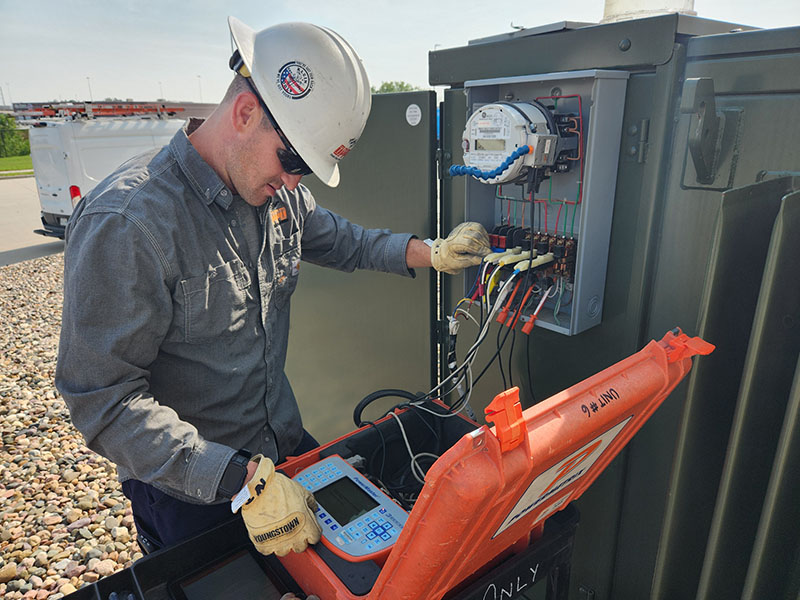
Nate Thies arrived at a suburban Omaha warehouse with electrical meter testing gear in a bright orange case.
Placing his equipment on a cart, the OPPD meter technician walked from his work van to one of a half-dozen green padmount transformer boxes on the property, opened the box and an attached customer meter, and began a routine but critical test.
Every year, OPPD meter technicians check the accuracy of meters that serve the utility’s 100 largest customers. All other big commercial and industrial users get the same test every five years to make sure everyone pays exactly what they owe and uses electricity efficiently.
Tracking usage correctly ensures accurate billing. Inefficient users also require greater amounts of electricity to meet their needs, which would require OPPD to generate more power.
“We want to make sure all of the meters are accurate,” Thies said. “If it’s even 1% off, that could be a big swing.”
Ensuring accuracy
Inaccurate readings that aren’t caught quickly could create billing issues down the road, so OPPD works proactively to find and correct problems, said Mike Iwanski, OPPD’s manager of Advanced Metering Infrastructure Transformation.
“The amount of energy that goes through those meters at any given point in time is huge,” Iwanski said.
Thies said the vast majority of meters pass the tests. Modern meters are all digital, while mechanical meters of the past used magnets and required manual calibration by turning dials.
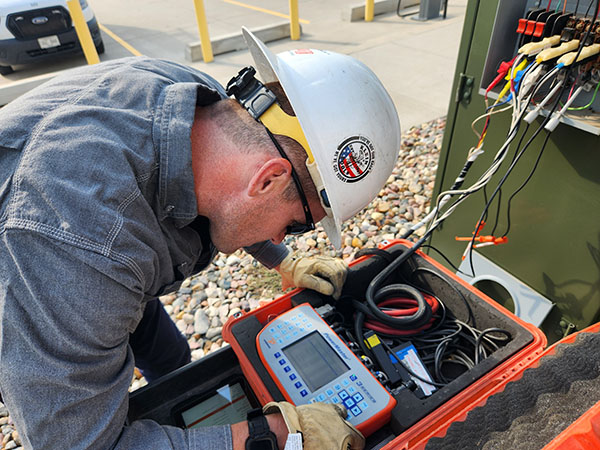
Inside Thies’ orange case is a special device that runs a test current through electrical meters without affecting the customer’s usage or bill. The test current provides a known reading that technicians can compare with what the meter shows.
The testing device pairs the two readings to make sure they’re accurate to within 0.2%. If the margin of error is larger, OPPD will generally investigate further or replace the meter.
OPPD’s review includes a full load test, a light load test and a power factor test. How does the meter perform with a full load running through it? What about with just a trickle of current?
“We do these tests just to make sure the meters can read different scenarios correctly,” Iwanski said.
Testing efficiency
Meter technicians also check each customer’s power factor, a measurement of how efficiently they’re using the electricity they receive.
Power factor is akin to pouring a cup of beer: You get the beverage itself (good, usable power) and a head (energy that is lost via dissipating heat before it can serve a useful purpose). Lower power factors waste money and electricity and may require special equipment, such as capacitors, to improve efficiency.
OPPD seeks a power factor of at least 90%, meaning the customer is using 90% of the electricity they’re receiving.
Using old, inefficient equipment is one way to create a bad power factor. A large customer with an extremely bad reading might have to pay additional charges due to the inefficiency of OPPD having to push extra energy to that user.
Technicians also look for signs of wear on older equipment. Occasionally, mice or squirrels will get into the padmount transformers and chew on the soy-based wire insulation. Birds may nest inside.
Promoting reliability
Meters that don’t pass their checks get replaced or adjusted so they’re providing the proper readings. Replacements don’t happen often since most meters function correctly.
“It’s not to say that it never happens, but it’s pretty rare,” Iwanski said. “But there’s still a benefit to getting our eyes on everything to make sure nothing is wrong.”
Larger customers also tend to work with OPPD’s senior account executives or electrical service designers, who might talk to them about ways to become more efficient.
“It’s all there to help protect the system and ensure reliable power,” Iwanski said.

Grant Schulte joined OPPD as a content generalist in 2022. He is a former reporter for The Associated Press, where he covered the Nebraska Legislature, state politics and other news for a global audience. He is a graduate of the University of Iowa and a proud Hawkeye. In his free time he enjoys running, reading, spending time with his wife, and all things aviation.
View all posts by Grant Schulte >